Diabetic foot: complications, stages and prevention
How does a diabetic foot develop?1
Diabetic foot is not a separate disease. It is the result of two problems that gradually develop with diabetes: damage to the nerves and disease in the blood vessels.
Nerve damage caused by diabetes affects the nerves in the feet. It gradually reduces the ability to feel pain, heat and pressure.
A small injury, rubbing from a shoe or a burn can then go completely unnoticed.
Disease in the blood vessels, on the other hand, reduces the blood supply to the feet. A wound that would easily heal elsewhere then takes much longer to heal, and sometimes does not heal at all.
These two problems often combine. Nerve damage, in particular, makes a deep ulcer on the sole of the foot more likely to develop. Repeated pressure on an area goes unnoticed because it causes no pain. Over time, a deep ulcer forms. When blood vessel disease is also present, it slows down wound healing even more. Without management, this wound spreads into deeper tissue, as far as a tendon or bone.
What are the symptoms of nerve damage caused by diabetes in the feet?
The most important sign is not pain: it's the absence of it. Nerve damage caused by diabetes often starts with tingling or pins and needles, then leads to a gradual loss of feeling. 2
Other signs you should look out for:
- drier skin on the feet, with cracks or hard, thick areas of skin
- a gradual change in the shape of the toes or the arch of the foot
- difficulty feeling the position of your foot while walking
Since pain no longer warns you, checking your feet regularly becomes your best tool for monitoring. Look at them every day, or get help from someone close to you if it's difficult for you.
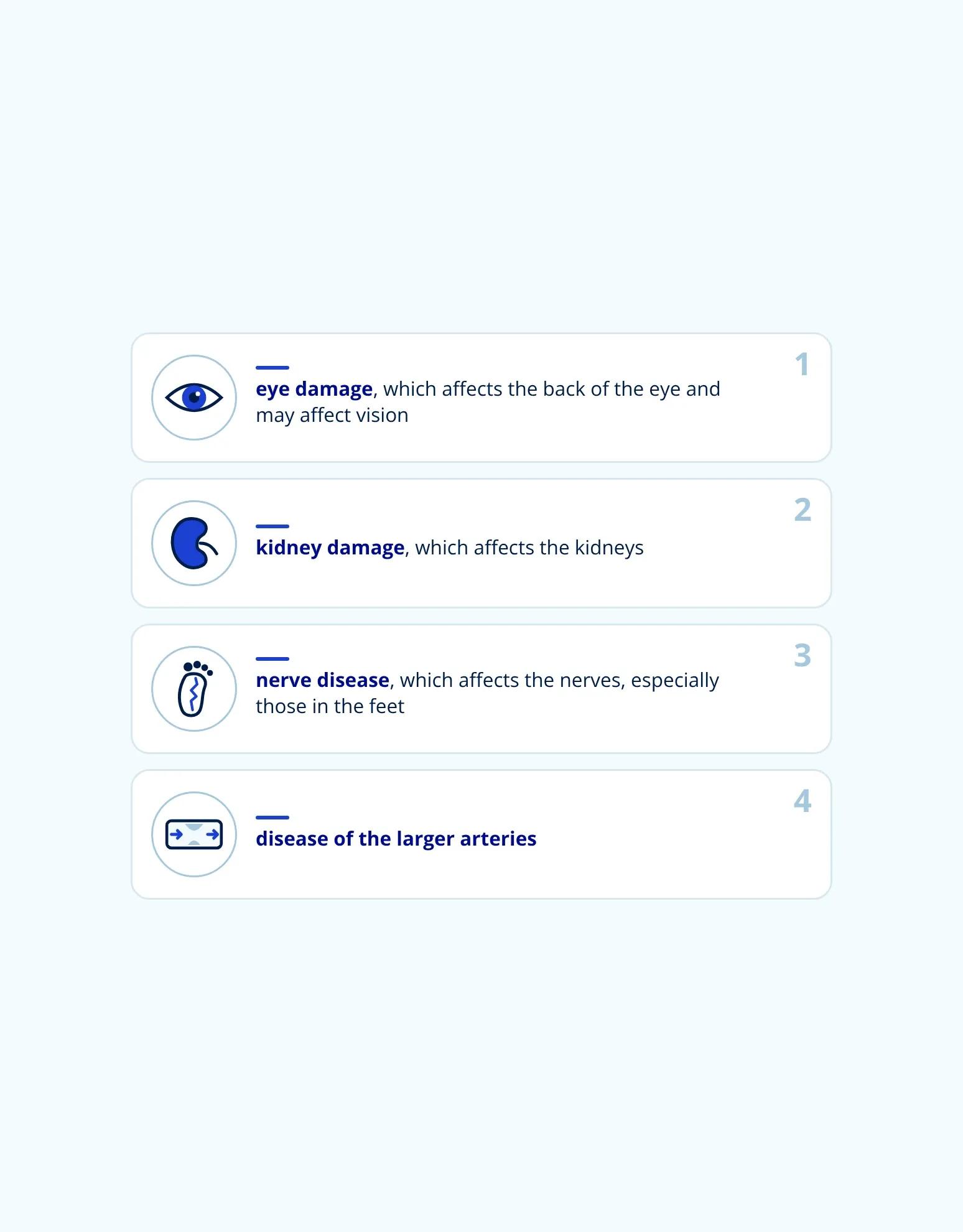
What are the 4 most common complications of diabetes?
Poorly controlled diabetes weakens the small blood vessels (small blood vessel damage) and the larger ones (large blood vessel damage). Together, they cause 4 common complications 3
Depending on their location, these disorders can affect the heart (chest pain, heart attack), the brain (stroke) or the legs. The form that affects the legs is called arterial disease of the lower limbs. It needs your close attention because of the risk to your feet. It reduces blood flow in the legs. Combined with nerve disease, it greatly increases the risk that a wound on the foot will not heal.3
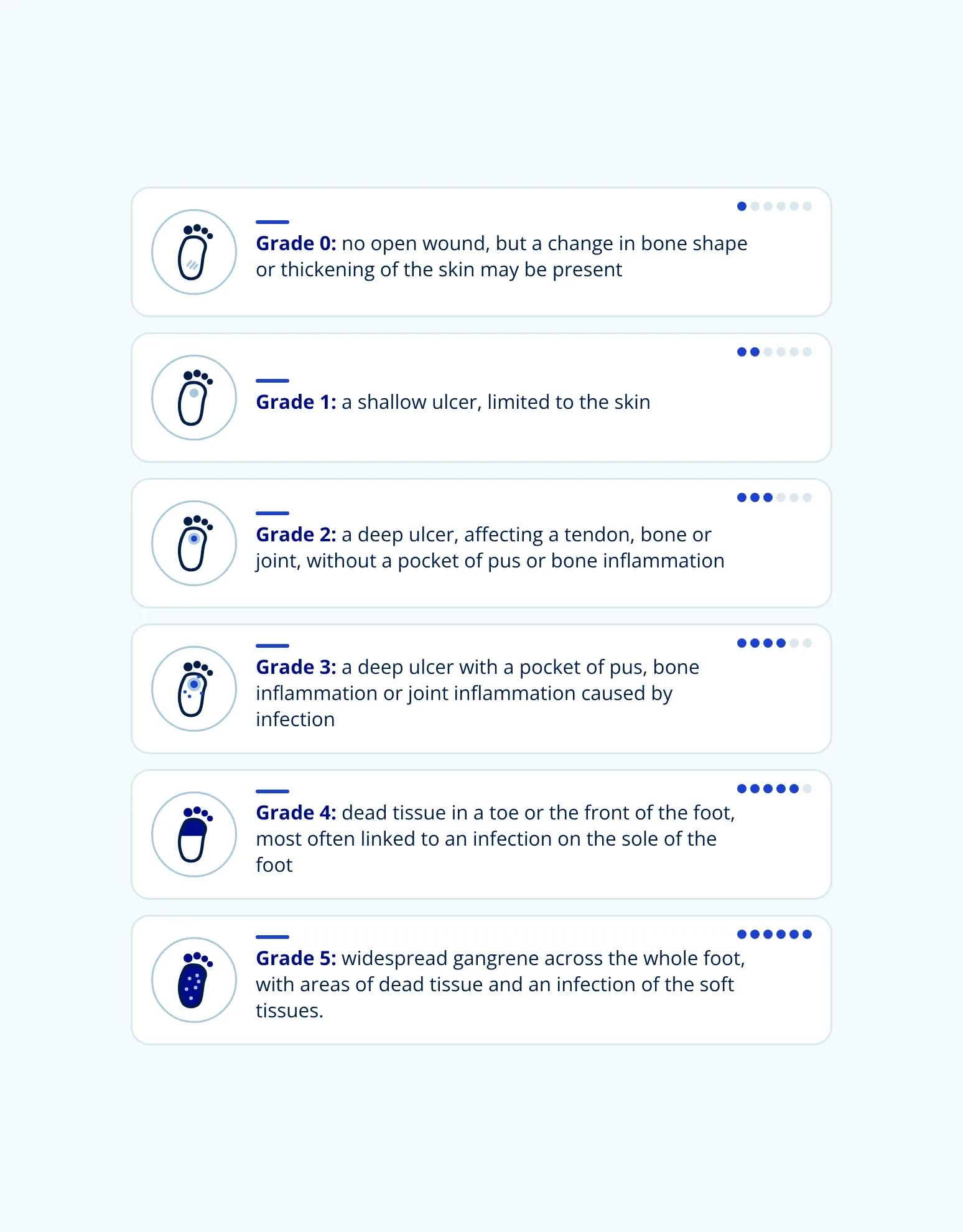
What are the stages of severity of diabetic foot injuries according to the Wagner classification?
Healthcare professionals use the Wagner classification to assess how serious a diabetic foot injury is. It consists of 6 levels, numbered from 0 to 5. 4
The earlier a wound is identified, the more treatment options there are. This is why it is important to see a healthcare professional as soon as a wound appears, even a small one.
What are the possible complications of a diabetic foot?
Without monitoring, a diabetic foot can lead to several complications. Up to one in three people with diabetes will develop a foot ulcer in their lifetime.5
The most common complications are:
- an infection of the wound, which may spread to the bone
- disease of the arteries in the arms and legs, present in about half of people with a foot ulcer5
- Charcot foot, a gradual change in the shape of the foot that is sometimes mistaken for simple redness and swelling
- a risk of amputation, as a last resort if the wound does not heal despite treatments
This last point needs a closer look: diabetic foot is the leading cause of amputation not caused by an injury. However, this risk is not inevitable. Regular checks and prompt management of any wound significantly reduce it.5
We explain the different types of amputation and options for rehabilitation on our dedicated page.
What are the possible complications of a diabetic foot wound?
A worsening diabetic foot wound often follows the same sequence. The infection first affects the skin and the tissue just below it. It can then reach the bone if it is not treated in time. 6
In the most severe cases, the infection can spread throughout the body or develop into gangrene. This means that tissue dies, most often due to a lack of oxygen (poor blood circulation) or a severe infection.6
These complications are not inevitable. They most often occur when the wound develops without management. A wound treated as soon as it appears develops very differently when the affected area is also kept at rest. 6
How can you protect your feet on a daily basis when you have diabetes?
6A few simple actions, repeated every day, significantly reduce the risk of complications:
- inspect your feet every night, including between the toes and under the arch of the foot
- moisturize dry skin, without applying cream between the toes
- Choose closed shoes with no rough seams and check the inside before putting them on
- Avoid walking barefoot, even at home.
- Do not treat hard, thick skin or an ingrown toenail yourself: consult a foot specialist.
- Have your feet examined at least once a year by your doctor or a foot specialist, more often if you have already had a wound.
A point to watch: if you also have a disease affecting your arteries, a medical professional must always approve the use of compression before you wear it. If used incorrectly, it can make already poor blood flow worse.7

- D. Malgrange, Pathophysiology of the diabetic foot, La Revue de Médecine Interne, Volume 29, Supplement 2, 2008, Pages S231-S237, ISSN 0248-8663, https://doi.org/10.1016/S0248-8663(08)73950-X.
- [Diabetic neuropathy: causes, symptoms and treatments]. (n.d.). https://www.federationdesdiabetiques.org/information/complications-diabete/neuropathie
- MSD Manuals. Long-Term Complications of Diabetes Mellitus. Professional Edition, Revised December 2025. Available on: https://www.msdmanuals.com/fr/professional/troubles-endocriniens-et-métaboliques/diabète-sucré-et-hypoglycémie/complications-à-long-terme-du-diabète-sucré
- Wagner FW. The diabetic foot. Orthopedics. 1987;10:163-172.
- Boulton AJM, Armstrong DG, Kirsner RS, et al. Diagnosis and Management of Diabetic Foot Complications. Arlington (VA): American Diabetes Association; 2018 Oct. Doi: 10.2337/db20182-1. Available on: https://www.ncbi.nlm.nih.gov/books/NBK538977/
- Schaper, N. C., Van Netten, J. J., Apelqvist, J., Bus, S. A., Fitridge, R., Game, F., Monteiro-Soares, M., Senneville, E., & IWGDF. (2023). Practical guidelines on the prevention and management of diabetes-related foot disease IWGDF 2023 update. In IWGDF Guidelines. https://iwgdfguidelines.org/wp-content/uploads/2023/07/IWGDF-2023-01-Practical-Guidelines.pdf
- De Loire, O. P. P. L. C. (2019, September 1). Compression for who, by who? [Proper use of medical compression bandages and stockings]. https://www.omedit-centre.fr/compression/co/Pour_qui__par_qui.html