They quickly invaded our daily lives, at home, at work... and to the great displeasure of our backs. Screens, computers, tablets and mobile phones are suspected of contributing to back pain, which affects seven to eight out of ten people during their lifetime, according to epidemiological data 1.
However, if excessive use can be the cause of various disorders (visual impairment, memory problems, overweight, etc.), for back pain, the real cause would be the poor posture adopted by users. To protect our back, we must therefore have the reflex to sit well in front of screens. Every day, the French spend an average of 5 hours and 7 minutes in front of a screen (4 hours and 11 minutes for children)2. So you need to know the right reflexes and as soon as possible!
Why do I have back pain at the office?
Science has highlighted a link between prolonged sitting and the emergence of low back pain. But the research went further in these results. Poor posture is associated with lower back pain, so people who have an adapted position are less likely to suffer from back pain3.
The causes can be a back that is too round or, on the contrary, too straight. There is also neck pain, which can be due to inappropriate extension of the neck to improve visibility in front of the screen, a screen placed too high or too low, or documents lying flat. These unsuitable postures lead to repeated flexion/extension of the neck, and therefore pain, reminds INRS 4.
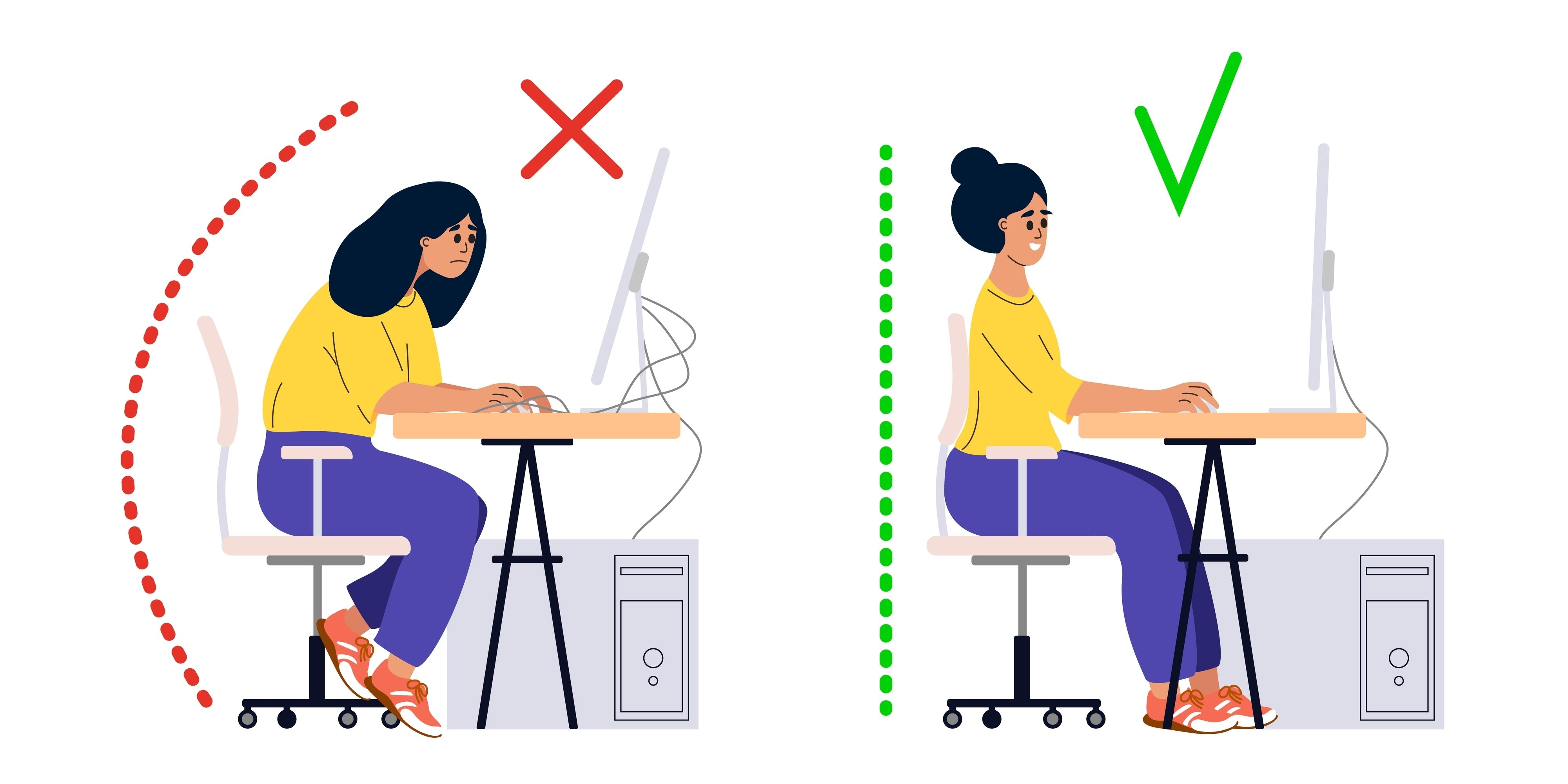
The right position to work on a computer4
Horizontal thighs, feet flat
Back (lumbar spine) resting on the backrest
Top of the screen at eye level (unless you wear progressive lenses: lower screen)
Arm-fore-arm angle greater than 90°, hands in extension
5-10 minute break every hour (move, walk, relax muscles)
Why do I have back pain when I hold my phone? The danger of the mobile phone.
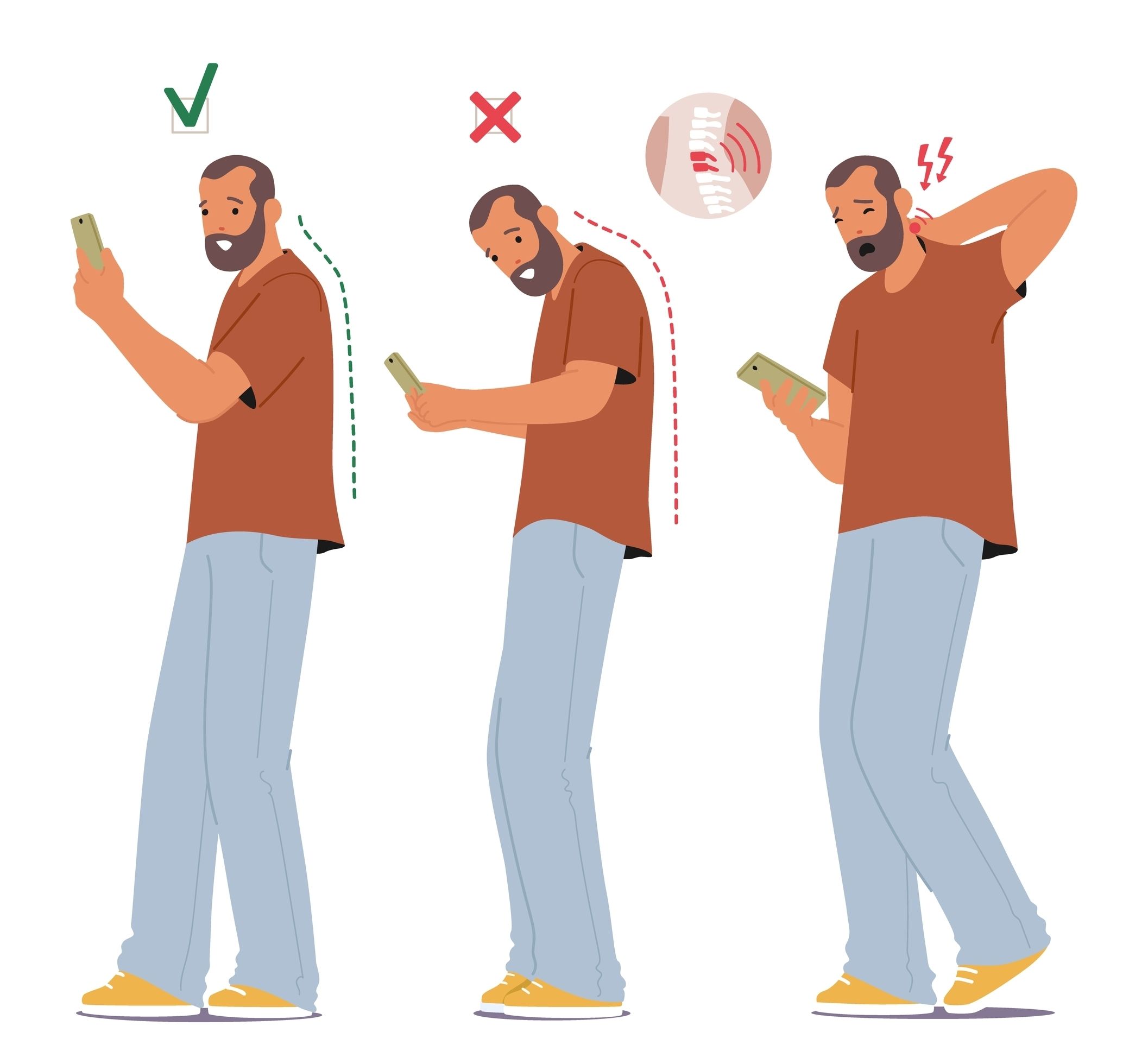
Neck pain is now a global public health problem. The growing addiction to mobile phones and computers has indeed triggered a new epidemic known as "Text Neck Syndrome"5. Using smartphones, tablets or laptops while looking down for long periods of time promotes poor posture, characterized by the head being thrown forward5. It is this unsuitable position that increases mechanical stress on the cervical spine and promotes the appearance of various symptoms, including neck pain and stiffness in the shoulders, especially in women6.
The causes can be certain unsuitable postures such as sitting with the back bent, device placed on the knees or on a flat surface. Such a posture induces forward bending of the neck, which increases the mechanical stress on the spine, which can promote muscle tension and pain in the neck and shoulders.
The Adapted Posture5
Head straight (neck close to the neutral position)
Device at eye level, at a comfortable distance for the eyes (approx. 30-40 cm) and elbows resting on a support if possible
Don't pinch the phone between the ear and the shoulder: use a hands-free kit
Take regular breaks, small circular movements to compensate for the position and gently mobilize the neck and shoulders
1 Back pain: a new tool for general practitioners, 2004, National Institute for Prevention and Health Education (now Santé Publique France).
2 Health study on the environment, biomonitoring, physical activity and nutrition (Esteban 2014-2016) - Physical activity and sedentary lifestyle chapter - published in February 2020 by Santé Publique France.
3 Association between sitting and occupational LBP, L. AM & al, European Spine Journal, 2006, DOI: 10.1007/s00586-006-0143-7
4 Screen-based work, fact sheet of the National Institute for Research and Safety for the Prevention of Occupational Accidents and Diseases (INRS), 2017
5 Tsantili, A., Chrysikos, D., & Troupis, T. (2022). Text Neck Syndrome: Disentangling a New Epidemic. Acta Medica Academica, 51, 123 - 127. https://doi.org/10.5644/ama2006-124.380.
6 Gender and posture are significant risk factors to musculoskeletal symptoms during touchscreen tablet computer use, Szu-Ping Lee et al., Journal of Physical Therapy Science, 2018, DOI: 10.1589/jpts.30.855
Prolonged sitting, especially in a bad position, can cause or aggravate back pain. This is especially the case in the car. So how do you avoid back pain when driving?
A sedentary lifestyle, the great enemy of our backs
A sedentary lifestyle is thought to play a major role in the epidemic of back pain that afflicts us today. Staying active, on the other hand, can help combat low back pain.