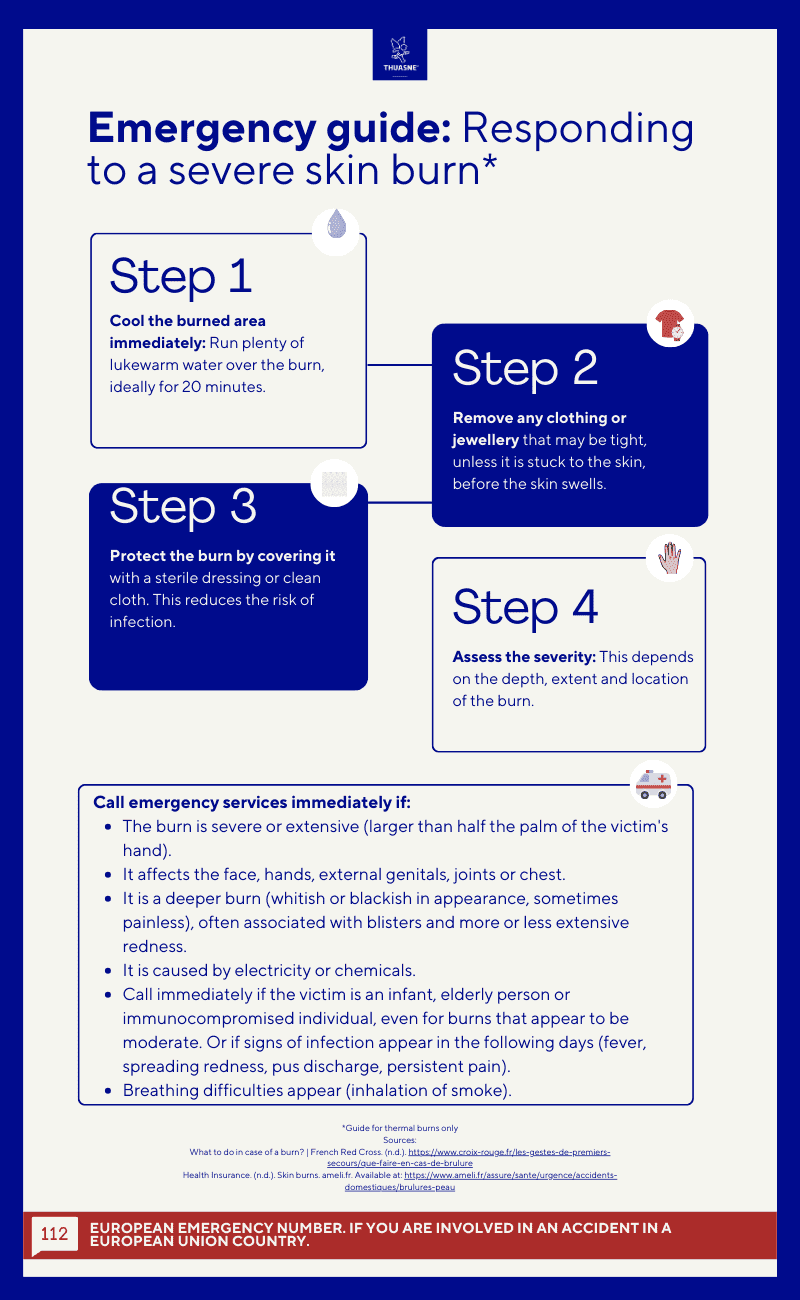
Emergency guide: What to do in case of a severe burn?
Discover the first aid gestures to adopt immediately in the event of a burn. Cooling, protecting, assessing severity... Follow the complete guide to react effectively before help arrives.
1. Keep the heat source away and protect yourself
First of all, move the victim away from the heat source (flame, hot liquid, steam, hot object) to prevent the burn from getting worse.
Never try to remove a garment that is stuck to the skin : this may tear the skin, but you can cut around it if necessary.
2. Cool the burned area immediately
This is the vital gesture : to cool the burn with water.
Run temperate water (15–25°C)at low pressure over the affected area for at least 10 minutes, ideally 20 minutes.
This gesture stops the spread of heat in the tissues, relieves pain and limits skin damage.
Never use ice, very cold water, or apply fatty substances (oil, butter, ointment).
3. Remove clothes and jewelry
If this does not cause additional pain or if they are not glued, promptly remove any rings, bracelets, watches or clothing around and over the burned area.
In the event of a chemical burn, remove clothing soaked in the product and rinse thoroughly with water for at least 20 minutes, unless the product is reactive to water.
4. Protect the burn
Once cooled, protect the burn with a clean, lint-free cloth (such as a cotton sheet or sterile compress).
Do not pop the blisters.
5. Assess the severity and call for help
The severity depends on the depth, extent,location of the burn and the age of the victim. Call for help if the burn is severe or extensive. Feel free to visit our page dedicated to severe burns to find out more.
Burns: When to go to the emergency room?
You should call the emergency services (15 or 112) if:
The victim is a child, an elderly person or an immunocompromised person. Medical advice may also be necessary if you notice signs of infection in the following days (fever, spreading redness, pus discharge, persistent pain).
Other factors that may prompt you to call for help:
If the burn affects the face, call 15, butalso if you notice breathing difficulties (it is indeed possible that the burn has reached the respiratory tract).
If the burn affects the body or limbs this time, you should call 15 if the burns affect the major joints (knees, elbows, shoulders) that could impair the victim's mobility.
Finally, the last clue as far as burns are concerned, a deep destruction can be seen by: whitish or blackish appearance, sometimes painless because of the damage to the nerves.
6. Monitor and reassure the victim
Keep the person at rest, away from any source of heat (such as the sun) or the cold, be very vigilant about the risks of hypothermia in the child following the cooling of the burn,and reassure the victim.
Monitor their breathing, consciousness and overall condition until help arrives (if necessary).
Even in the case of a simple or light burn, do not hesitate to seek medical advice
7. After First Aid
A burn, even a slight one, should be monitored for several days.
If the pain intensifies, if the wound becomes red, swollen or oozing, as mentioned above, consult a doctor quickly : it may be an infection.
For severe burns , medical care is essential to limit the risk of complications and skin sequelae.
What you should never do
Apply ice or very cold water.
Add toothpaste, butter, oil or any other fat.
Pierce the blisters.
Stick an adhesive bandage directly to the burned skin.
Remove a garment that is stuck to the skin.
Do not use make-up or cosmetics during healing.
Do not touch unclean and washed hand burns
Do not use harsh disinfectant products that irritate the fabrics
Are you coming back from the beach or a day outdoors with red and painful skin? Every year, more than one third of people get sunburn. Sunburn is often not taken seriously. It is seen as a small problem that will soon pass. Yet, at the back of this redness, there is a serious inflammatory reaction with real effects.
The principle of compression prevents the appearance of keloids and hypertrophic scars. Compression helps to flatten and soften scar tissue, improving its appearance.