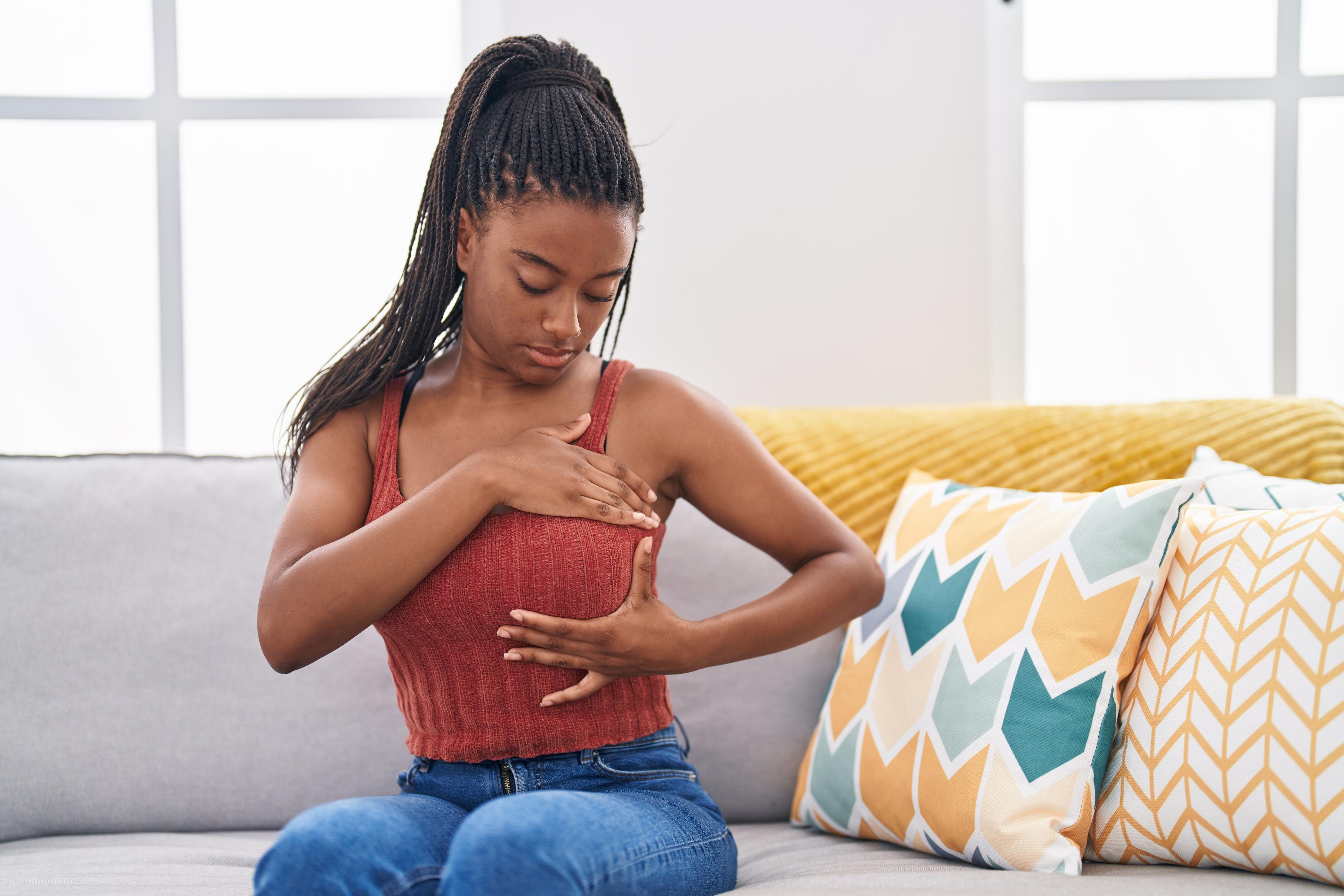
Every year, nearly 2.3 million women worldwide are diagnosed with breast cancer, making it the most common cancer in women globally ¹. It is a cancer with a good prognosis: detected at an early stage, the 5-year survival rate exceeds 88%². This figure is a reminder of how individual vigilance can make a real difference, no matter where you live.
Breast self-examination is the action of observing and palpating your own breasts regularly, looking for any changes. It does not replace an annual clinical examination by a healthcare professional or mammograms. However, it can help you become more familiar with your body, recognize unusual changes sooner, and seek medical advice without delay.³
When to perform self-examination?
Ideally, once a month, a few days after your period ends, when your breasts are less swollen and tender ⁴. For postmenopausal women, choose the same day each month, to make it an habit.
The challenge is not to detect something worrying every time, but to familiarize yourself with your breasts : their natural shape, their texture, their usual small asymmetries. This basic knowledge will help you notice any new changes.⁵
The steps: how to do it?
1. Visual inspection, arms at the side of the body
Stand in front of a mirror with your arms relaxed at your sides. Observe both your breasts carefully: their shape, their size, their symmetry. Look at the skin on the surface — it should be smooth, without wrinkles, redness, or an "orange peel" appearance ⁶.
2. Visual inspection, arms raised
Raise both arms above your head and observe again. This position highlights contour variations or distortions that would not otherwise be visible⁶.
3. Circular palpation
With the pulp of the three middle fingers (index finger, middle finger, ring finger), feel the opposite breast in small circular movements, starting from the outside of the breast and gradually spiraling towards the nipple. Cover the entire breast with light to moderate pressure, then repeat on the other side ⁷.
4. The armpit area
Don't forget the area between the breast and the armpit. Axillary lymph nodes can sometimes be a warning sign: report any persistent swelling to your healthcare professional ⁶.
5. Nipple check
Gently squeeze each nipple between your thumb and forefinger. In the absence of pregnancy or breastfeeding, there should be no spontaneous discharge. Any unusual discharge — especially bloody or yellowish — warrants an immediate consultation ⁸.
6. Start again on the other side, then lie down
Repeat all the palpation gestures for the second breast. You can also perform the examination lying down, placing a cushion under the shoulder on the side being examined: this position allows you to explore the breast tissue more deeply ⁷.
What are the warning signs?
Consult your doctor or gynecologist right away if you notice any of the following signs ⁹:
An unusual lump, nodule, or hardening
A change in the shape or size of your breast
A change in the skin: folds, hollows, redness, orange peel appearance
A retraction or deviation of the nipple
Spontaneous discharge from the nipple
Swollen lymph nodes under the armpit
These signs do not always indicate cancer — the vast majority of abnormalities detected are benign ⁸. But they still deserve prompt medical advice.
What self-examination does not replace
It is important to be honest about what self-examination can and cannot do.
Scientific studies have not shown that breast self-examination alone reduces breast cancer mortality¹⁰. This is why the health authorities do not recommend it as an organized screening method, but encourage health professionals to promote its practice as a tool for raising awareness and knowing the body ³.
Self-examination is part of a comprehensive prevention approach, which includes:
A clinical breast examination by a healthcare professional, recommended at least once a year¹¹
Participation in organized screening programs available in your country (mammography according to local recommendations)¹²
Pink October: a month to act
Every October, the Pink October campaign mobilizes associations, health professionals and companies around the world to raise awareness about breast cancer screening. It is an opportunity to talk openly about these simple gestures, to learn them, to pass them on.
At Thuasne, we are committed to supporting you every year, because women’s health is at the heart of our mission.
Do you have any doubts? Talk to your doctor. Never postpone a consultation that you feel is necessary.
¹ IARC/IARC — Global Cancer Observatory, Global Cancer Estimates 2022, 185 countries covered. → https://gco.iarc.who.int/today
⁷ Ligue contre le Cancer — Official method of breast self-examination (3-finger technique, circular movements from the outside to the nipple, standing and lying position with cushion under the shoulder).
Regaining self-confidence after a mastectomy is a challenge for many women. This ordeal can profoundly affect self-esteem and body image. However, it is possible to regain emotional balance.
After diagnosis: get informed and prepare to fight breast cancer!
Receiving a diagnosis of breast cancer turns your life upside down. However, medical knowledge and treatments have advanced enormously. Today, many women are living and rebuilding their lives after this disease.