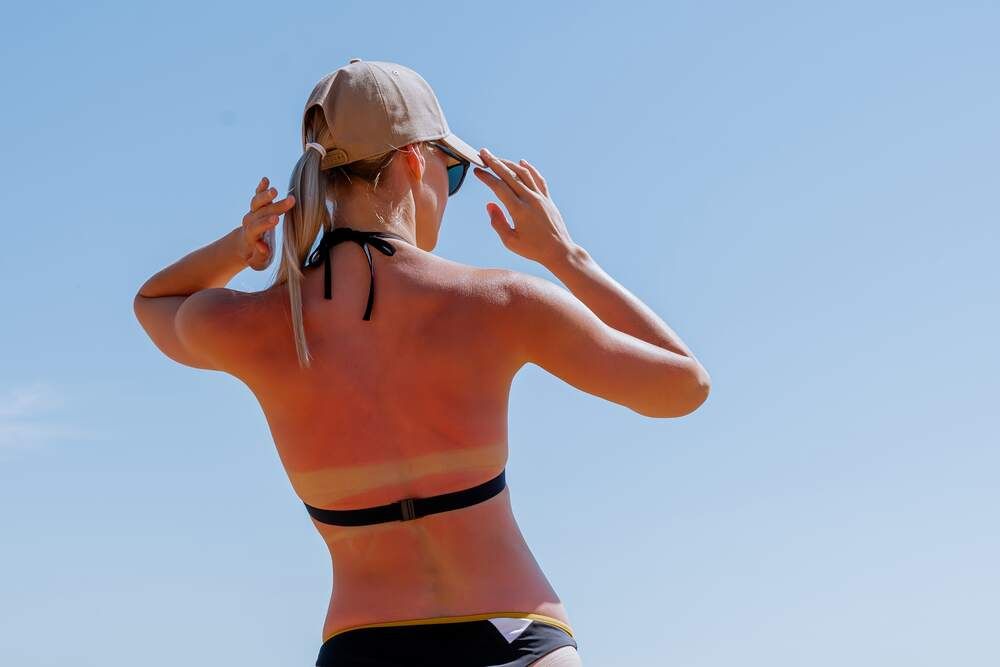
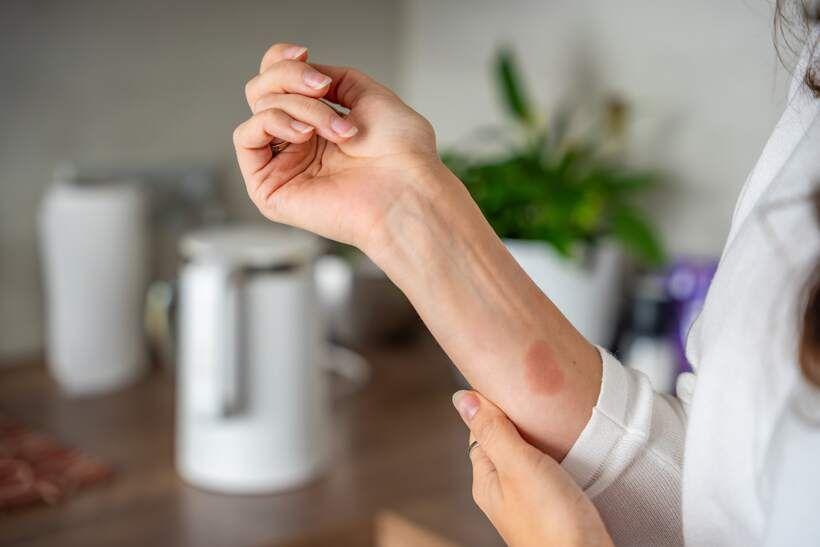
Are you coming back from the beach or a day outdoors with red and painful skin? Every year, more than one third of people get sunburn. Sunburn is often not taken seriously1. It is seen as a small problem that will soon pass. Yet, at the back of this redness, there is a serious inflammatory reaction with real effects.
What is sunburn?
Sunburn is an inflammatory reaction of the skin caused by too much exposure to the sun’s ultraviolet (UV) rays. UVA and UVB rays damage the DNA of skin cells, either directly or by creating very reactive molecules called free radicals.1
In response, the body starts repair processes and removes cells that are too damaged. This reaction also releases inflammatory substances. These substances widen blood vessels and stimulate nerve endings. This causes the common signs of sunburn: redness, heat, swelling and pain.1
Redness usually appears 3 to 5 hours after exposure. It reaches its highest point after 12 to 24 hours, then fades in 3 to 7 days. In the most severe cases, blisters may appear. General symptoms such as nausea, fever and chills may also appear.1
Can you go in the sun with sunburn?
Burnt skin may become extremely sensitive to the sun’s rays, and it is essential to avoid any new exposure until it has fully healed2,3. This is not only about comfort. Going back into the sun would make the damage already caused to skin cells worse and would delay wound healing.
Very burnt skin may peel several days after exposure. This is a sign that the repair process is still happening. It is important not to pull off this peeling skin. During 3this whole time, it remains weak and without protection against UV rays.2,3
Can sunburn be dangerous?
Sunburn is not just a temporary red mark: it is a warning sign that the Skin has suffered real damage.
UV rays are classified as carcinogenic For men by the International Agency for Research on Cancer (IARC), because of their proven genotoxic effect. And the danger starts early: repeated sunburns during childhood and the teenage years4 (altération de l'ADN des cellules)increase the Risk of melanoma later in life.4
Melanoma, a cancer that is rising sharply
The number of skin melanoma cases was multiplied by almost 5 Between 1990 and 2018, with more than 15,000 new CASES PER YEAR IN FRANCE. According to the IARC, about 83.5% of skin melanomas may be due to sun exposure.4
When should you worry about sunburn?
Most sunburns heal in a few days Without medical treatment. But in some cases, they may become a Severe5,6 form, which needs special care.
The seriousness of sunburn mainly depends on how long and how strongly the Skin is exposed to UV rays, so it is important to limit this exposure.1
See YOUR doctor if3
A large area of the body is affected.
A fragile area is affected, especially the Face, hands, or genitals.
Sunburn causes blisters to appear on the affected area.
You notice a visible infection (oozing, PAIN).
You have Head pain, confusion, nausea, fever, or chills.
In a serious emergency: high fever With or Without vomiting, mental confusion, signs of dehydration, dizziness, or a feeling of Cold or chills, seek medical advice immediately.6-5
What complications can it cause?
People with severe sunburn causing large blisters may be at Risk of losing fluids and mineral salts. This can lead to dehydration and a Risk of Skin infection.6
In the longer term, repeated sun exposure speeds up Skin aging before its time and significantly increases the Risk of Skin cancers1,4. The eyes are also vulnerable: too much UV exposure can damage the cornea and may contribute to cataracts.5
How can you prevent sunburn?
The good news is that sunburn can largely be avoided. A few simple steps, used carefully, are enough to greatly reduce the Risk.
Avoid the most dangerous hours
The sun’s rays are strongest Between 10 a.m. and 4 p.m. When the sun is at its highest, UV rays are the most dangerous: it is recommended to avoid sun exposure especially Between these hours and to choose Shadow.1,5
Using sunscreen Cream well*
It is important to apply sunscreen Cream With a SPF 30 Index minimum, even on cloudy days, and to reapply it every two hours and after each swim.1,4 Choose broad-spectrum Protection that covers both UVA and UVB.
*Important: None sunscreen Cream, whatever the Protection Index, even if it is high, can give 100% Protection. The best Protection is to stay in Shadow and cover the Skin and eyes.4
Cover up and protect the most vulnerable
For the best anti-UV barrier, choose covering clothes, a wide hat, and filtering sunglasses. Be extra careful With children, whose fragile Skin makes the Risk of sun-related cancer ten times higher. As for very young children under three years old, they must be kept strictly in Shadow.4
Avoid UV booths
Artificial UV rays from tanning equipment are classified as carcinogenic For men. It is strongly advised not to be exposed to them.4
Guerra KC, Crane JS. Sunburn. [Updated 2023 Oct 29]. In:StatPearls [Internet]. Treasure Island (FL): StatPearls Publishing; 2026 Jan-. Available from: https://www.ncbi.nlm.nih.gov/books/NBK534837/
Emergency guide: What to do in case of a severe burn?
Discover the first aid gestures to adopt immediately in the event of a burn. Cooling, protecting, assessing severity... Follow the complete guide to react effectively before help arrives.
Heavy legs in summer: causes, advice and solutions to feel comfortable again
In summer, the feeling of heavy legs is a common discomfort, especially when it is hot. It is often linked to less efficient venous circulation, helped by the widening of the veins. Luckily, simple steps can improve daily comfort.