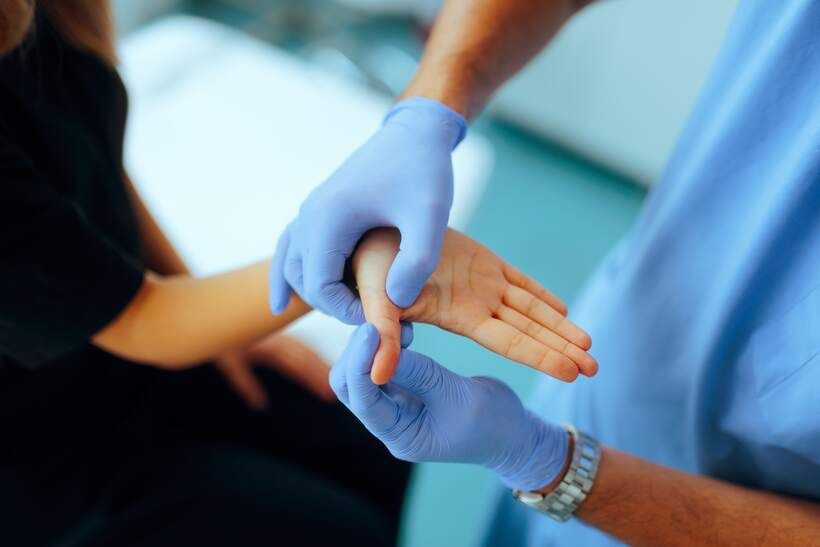
An awkward fall, a hard hit during a sports activity, and it can happen: Thumb sprain is a common injury that can quickly become limiting and painful.
The thumb
The Thumb is the first finger of the Hand and is responsible for about 40% of the Hand’s overall function. Its unique body structure allows(1) it to make both power grips (such as holding a hammer) and Precision grips (such as holding a needle or writing).
In fact, the Thumb is moved by a complex system of eight main muscles, divided into two groups: extrinsic muscles (involved in overall movement and strength) and intrinsic muscles (involved in fine adjustment and stability).
How does thumb sprain happen?
Thumb sprain is a common injury. It can happen during an awkward fall or a hit (for Example in sports where you need to catch and throw a ball With the Hand). It happens when a ligament in the Thumb, at the joint, stretches in an unusual way or tears2.
How do you know if you have a thumb sprain(2)?
If you have injured yourself, your body will send you clear signs. The symptoms of a Thumb sprain can vary depending on the grade of the sprain:
Grade 1: Mild sprain
This is the least serious stage, often linked to a minor injury.
What happens: Ligament in your Thumb has been stretched beyond its normal limits, but there is no tear.
Symptoms: Pain or instability at the base of the Thumb, slight swelling, and sometimes a bruise.
Grade 2: Moderate sprain
At this stage, the injury is more serious.
What happens: Ligament is partially torn.
Symptoms: Pain and swelling are stronger, often with a bruise and limited movement of the Thumb.
Grade 3: Severe sprain
This is a serious injury that needs medical assistance and sometimes surgery.
What happens: Ligament is completely ruptured (complete tear). In some cases, the ligament is pulled away from its base and takes a small piece of bone with it: this is called an avulsion fracture(3).
Symptoms: Strong pain, immediate and major swelling, being unable to pinch or hold objects firmly, and instability of the Thumb.
Taking painkillers such as non-steroidal anti-inflammatories (NSAIDs), such as ibuprofen, may help relieve pain and inflammation. However, if pain and swelling last more than 48 hours, you must see a doctor(3).
Immobilization : In some cases, the ligament needs time and stability to repair itself.
The splint: Your doctor may prescribe a splint for a period of 2 to 4 weeks(4). This will allow you to move according to your tolerance to pain, while blocking strong strain.
The cast (less common): In rare cases, your thumb may be immobilized in a cast or a rigid splint for the same period of 2 to 4 weeks(4).
Severe sprain
In the most severe cases, especially when a Ligament tear is linked to a fracture(4) or when the joint is unstable during the physical exam(4), surgery may be needed(4).
What is the role of the physiotherapist in Thumb sprain?
The physical exam (the stability test)(3)
The doctor will gently move your thumb in different directions. They want to assess the “laxity” of the joint. If the thumb moves too much or seems “loose”, this is a sign that the ligament is badly torn.
X-rays(1)
This exam is done to check that there is no broken bone, or to find an avulsion fracture (when the torn ligament pulls away a small piece of bone with it). Sometimes, the doctor may ask for a “stress” X-ray (by applying a light pressure on the thumb) to make joint instability visible in the image.
The role played by the physiotherapist
After Treatment and possible Immobilization, your thumb may be stiff and may have lost strength.
The physiotherapist will set up a targeted exercise programme to help you regain strength and range of movement in your thumb and your hand(2).
FAQ
The healing time for a Thumb sprain depends on how serious the injury is. If your doctor tells you to wear a splint or a cast, your thumb may be immobilized between 2 and 4 weeks(4). You may still be able to use your hand for daily activities that do not put too much strain on the thumb.
Depending on how serious it is, pain may last up to 12 weeks, while full recovery (strength and movement) may take several months(4).
Taking painkillers such as non-steroidal anti-inflammatories (NSAIDs), like ibuprofen, may help relieve pain and inflammation(3). However, if the pain lasts for more than 48 hours, you must see a doctor.
In the case of a mild or moderate sprain, depending on how serious it is, it may be possible to follow this at home protocole RICE.
Also remember to protect your injury from any further damage by using a support or a splint. It is better to avoid wearing an arm sling to keep the hand raised. This may cause discomfort and stiffness in your neck and shoulders(3).
Finally, keep to very light activities: it is recommended to avoid lifting moderate to heavy loads, pulling, or pushing during the first four weeks(4).