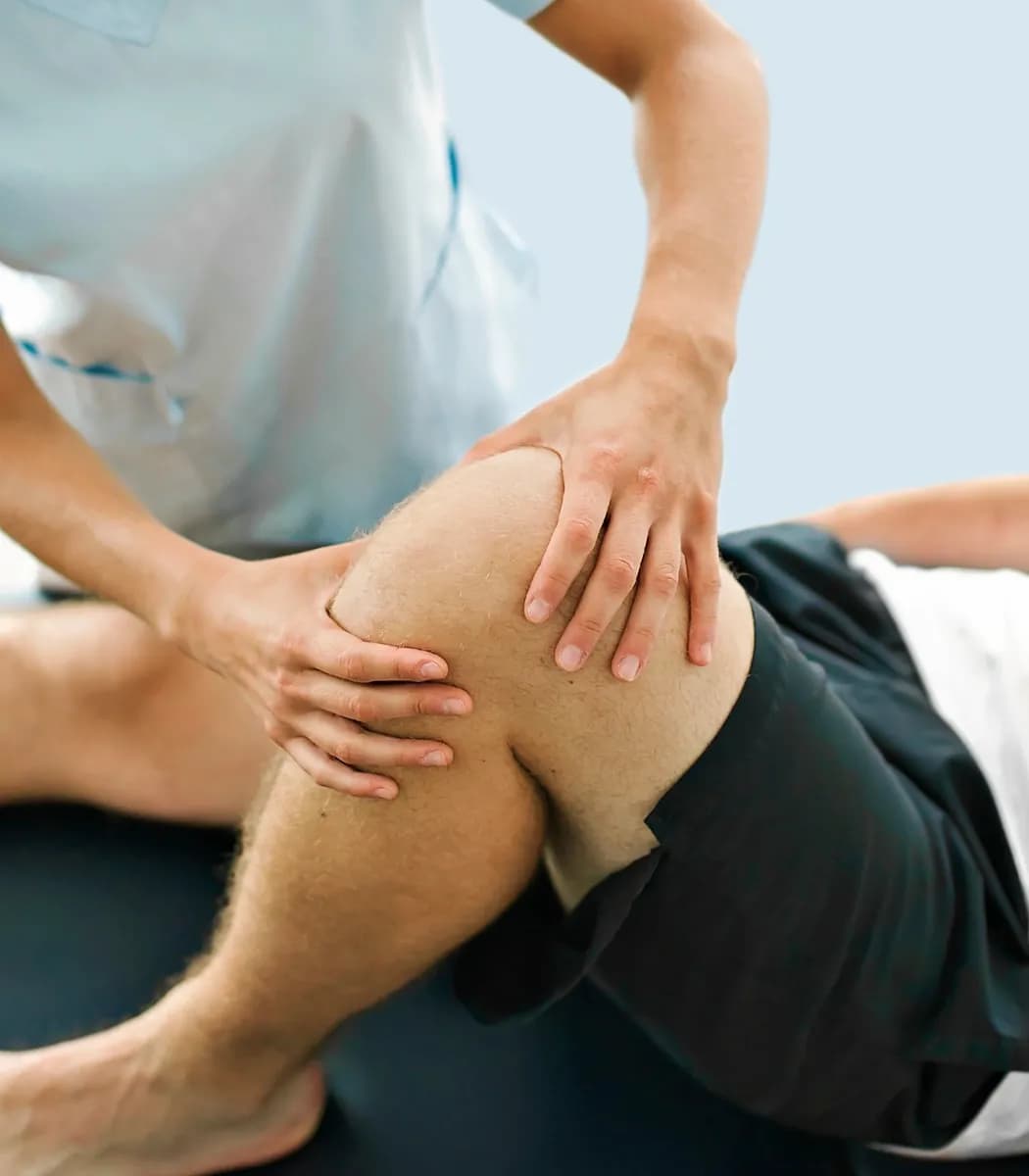
What is an anterior cruciate ligament (ACL) rupture and what are the treatments?
The rupture of the anterior cruciate ligament (ACL) corresponds to the tearing of a ligament essential to the stability of the knee. It often occurs during sports activities. Treatment is based either on rehabilitation alone, on surgery followed by rehabilitation or rehabilitation followed by possible surgery, depending on age, activity level and knee instability(1.2).
How do you know if you have a ruptured ACL ?
An ACL rupture often occurs after a sudden movement sometimes accompanied by a "cracking" sound, followed by rapid swelling and an unstable knee sensation(3). The diagnosis is based on various elements: the patient's history, the clinical examination (including the Lachman test) and, if necessary, a confirmatory MRI(1.4).
Can you walk with a cruciate ligament rupture?
Yes, it is possible to walk with an ACL rupture. Studies show that many patients continue to walk, sometimes adapting their gait, with a slower speed and a reduction in joint amplitude, both in flexion and extension. On the other hand, this walk is often done with muscle compensation mechanisms and a different solicitation of the knee, which can, in some cases, increase joint stress and alter the distribution of loads at the knee(5.6).
Can you run with a cruciate ligament rupture?
Running with a ruptured ACL is more complicated than walking. Without a functional ligament, the knee is less stable, especially when changing direction or pressing quickly(7). Some people can run in a straight line after rehabilitation, but the risk of slippage and new lesions (meniscus, cartilage) remains high, which explains why resuming running should always be supervised by a health professional(8.9). Available study data suggest that non-surgical management of ACL ruptures offers only limited results and that, in physically active individuals wishing to return to the same level of activity, reconstructive surgery may be the most appropriate decision(6).
Is it possible to bend the knee with a ruptured ligament?
Yes, it is possible to bend the knee despite an ACL rupture. However, range of motion can be reduced: some people spontaneously limit flexion and/or extension, which can change the way you walk and put different strain on the muscles and joint(5.6).Nevertheless, range of motion should be restored quickly, while trying to avoid worsening pain and edema(9). If the patient persists that the range of motion does not improve, then it may be a displaced meniscal tear and surgery may be necessary(9). You may also be offered isometric exercises very soon after injury to prevent muscle atrophy and loss of strength(9). The so-called "full active extension" and normal gait should be attempted within the first 7 to 10 days(10). Within one to three weeks, the inflammatory phase should slowly subside(9).
Filbay, S. R., & Grindem, H. (2019). Evidence-based recommendations for the management of anterior cruciate ligament (ACL) rupture. Best Practice & Research Clinical Rheumatology, 33(1), 33–47. https://doi.org/10.1016/j.berh.2019.01.018
François-Xavier Gunepin, Romain Letartre, Caroline Mouton, Pierrick Guillemot, Harold Common, Patricia Thoreux, Rémi Di Francia, Nicolas Graveleau,Construction and validation of a functional diagnostic score in anterior cruciate ligament ruptures of the knee in the immediate post-traumatic period. Preliminary results of a multicenter prospective study, Orthopaedics & Traumatology: Surgery & Research,Volume 109, Issue 8, Supplement, 2023,103686, ISSN 1877-0568, https://doi.org/10.1016/j.otsr.2023.103686
Benjaminse, A., Gokeler, A., & Van der Schans, C. P. (2006). Clinical diagnosis of an anterior cruciate ligament rupture: a Meta-analysis. Journal of Orthopaedic and Sports Physical Therapy, 36(5), 267–288. https://doi.org/10.2519/jospt.2006.2011
Huang, H., Yin, W., Ren, S., Yu, Y., Zhang, S., Rong, Q., & Ao, Y. (2019). Muscular Force Patterns during Level Walking in ACL-Deficient Patients with a Concomitant Medial Meniscus Tear. Applied Bionics and Biomechanics, 2019, 1–8. https://doi.org/10.1155/2019/7921785
Aghdam, H. A., Haghighat, F., Rezaie, M., Kavyani, M., & Karimi, M. T. (2022). Comparison of the knee joint reaction force between individuals with and without acute anterior cruciate ligament rupture during walking. Journal of Orthopaedic Surgery and Research, 17(1), 250. https://doi.org/10.1186/s13018-022-03136-y
Fitzgerald, G. K., Axe, M. J., & Snyder‐Mackler, L. (2000). A decision‐making scheme for returning patients to high‐level activity with nonoperative treatment after anterior cruciate ligament rupture. Knee Surgery Sports Traumatology Arthroscopy, 8(2), 76–82. https://doi.org/10.1007/s001670050190
Kotsifaki, R., Korakakis, V., King, E., Barbosa, O., Maree, D., Pantouveris, M., Bjerregaard, A., Luomajoki, J., Wilhelmsen, J., & Whiteley, R. (2023). Aspetar clinical practice guideline on rehabilitation after anterior cruciate ligament reconstruction. British Journal of Sports Medicine, 57(9), 500–514. https://doi.org/10.1136/bjsports-2022-106158
Cadena, D. C. M. P. B. E. C. G. D. E. G. U. J. F. V. M. F. D. P. R. K. N. C. G. G. V. V. V. (2023, January 17). ANTERIOR CRUCIATE LIGAMENT, DESCRIPTION, RUPTURE AND TREATMENT. EPRA Journals. https://eprajournals.com/IJMR/article/9974
Aghdam, H. A., Haghighat, F., Rezaie, M., Kavyani, M., & Karimi, M. T. (2022b). Comparison of the knee joint reaction force between individuals withand without acute anterior cruciate ligament rupture during walking. Journal of Orthopaedic Surgery and Research, 17(1), 250. https://doi.org/10.1186/s13018-022-03136-y
How long does rehabilitation for an anterior cruciate ligament injury take?
Anterior cruciate ligament (ACL) rupture is a common injury, particularly among athletes. It requires long-term, structured treatment, whether or not surgery is involved.
Ruptured cruciate ligaments, particularly the anterior cruciate ligament (ACL), can be treated using different approaches depending on the severity of the injury, the patient's lifestyle and recovery goals.
Feeling like your knee is "loose" can be worrisome. This sensation can occur after a trauma, but also in simple everyday gestures. Understanding what knee instability is, its symptoms, causes and possible solutions is a first step to better act and protect your joint.