How long does rehabilitation for an anterior cruciate ligament injury take?
Anterior cruciate ligament (ACL) rupture is a common injury, particularly among athletes. It requires long-term, structured treatment, whether or not surgery is involved. The duration of rehabilitation varies depending on the treatment chosen, the patient's profile and the rigour of the physiotherapy programme. Let's take a look at the key stages and average recovery times.
What are the phases of rehabilitation after anterior cruciate ligament surgery?
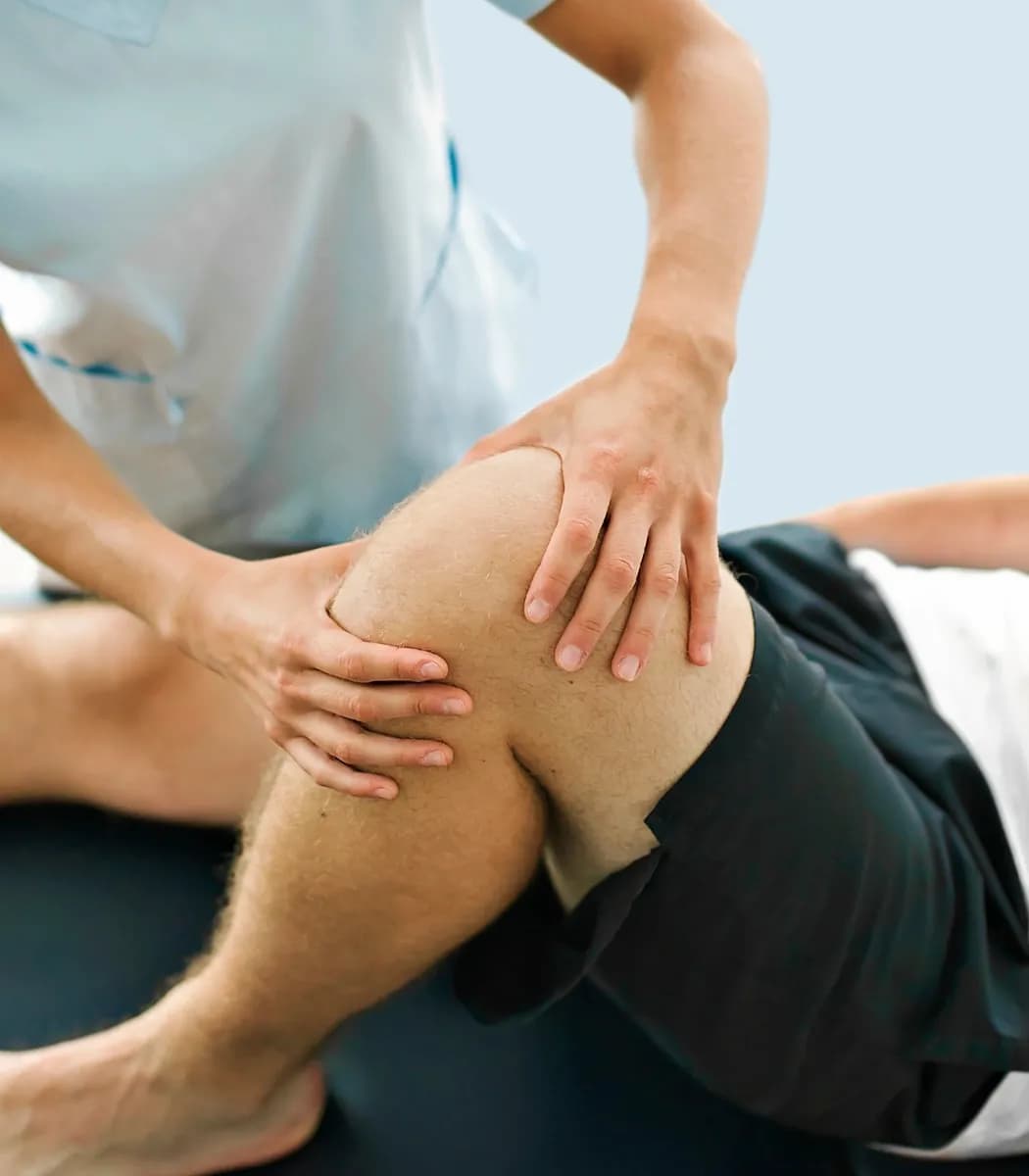
After ligament reconstruction, rehabilitation is essential to restore mobility, strength and stability to the knee. It usually begins in the first few days after surgery, under the supervision of a physiotherapist. The transition from one phase to another is only done under their supervision.
Here are the different phases of post-operative rehabilitation(1) put in place for a gradual return to sporting activities:
Extension and muscle awakening phase
This first stage takes place in the two weeks following the operation. The aim is to regain full knee extension, reactivate the quadriceps, reduce swelling and begin to gently bend the leg. You will also learn to walk with crutches without limping, in order to regain a natural gait.
Stability phase
Once it is possible to fully extend the leg and walk without limping, the focus shifts to stabilising the pelvis and trunk. This involves learning to stand properly on both legs, lift the operated leg without difficulty, and gradually bend the knee . By the end of this phase, you should be able to go up and down stairs without discomfort.
Strengthening phase
This stage aims to restore strength to the operated leg and improve balance. The exercises become more intense and more focused on muscle control. It is also at this point that a gradual and supervised return to jogging is considered.
Jumping phase
The focus now shifts to mastering jumps and building muscle strength. You will learn how to achieve sufficient stability to move on to changes of direction.
Change of direction phase
The final stage of the protocol involves regaining full coordination in dynamic movements. You will now learn how to master jumps safely, with symmetrical landings. The aim is for the strength and stability of the operated leg to be almost equivalent to that of the other leg. This phase begins in the fifth month, once the muscles have been properly rebuilt and the knee is ready to withstand more intense effort.
A knee ligament injury requires a minimum of three months' rest from sport for the most minor injuries and sometimes more than a year for the most serious injuries (knee dislocation). On average, athletes can return to training for linear sports after three months and for pivoting sports (football, skiing, basketball) and contact pivoting sports between six and nine months after surgery(2),according to the recommendations of the French College of Orthopaedic Surgeons and Traumatologists.
How long does full rehabilitation take?
Cruciate ligament rehabilitation takes 6 to 12 months, with progression in several stages(5). Returning to sport prematurely greatly increases the risk of re-rupture.6 Physiotherapists often use functional tests (isokinetics, jumps, agility and coordination exercises ) to validate each stage(5).
How long does it take for a ligament to heal?
The healing of a reconstructed ligament is a slow process: the graft (often a tendon taken from the patient) must transform into ligament tissue. This phenomenon, called ligamentisation, takes 6 to 12 months according to imaging and biomechanical studies nique(7).
During this period, the knee remains fragile: vigilance and adherence to rehabilitation instructions are essential to avoid secondary tearing.
What factors affect recovery?
Several factors influence the speed and quality of recovery after an anterior cruciate ligament rupture.
One of the most important factors is patient involvement in their rehabilitation. The more regularly and intensively the programme is followed, the better the results and the faster the return to activities(3).
The psychological dimension also plays a major role: confidence in one's knee and mental preparation are key to a successful return to sport(4).
The timing of surgery can also influence recovery. Surgery performed very early, within the first two weeks, sometimes promotes faster recovery of muscle strength, but most specialists prefer to wait until the knee has returned to a low level of inflammation before operating(5).
Finally, caution is essential when returning to sport. Returning to the field less than nine months after surgery increases the risk of re-injury sevenfold, especially in young athletes. A gradual return, approved by a physiotherapist and doctor, remains the best guarantee of a lasting recovery(6).
Can an anterior cruciate ligament rupture be treated without surgery?
Yes, in some cases(9).
For people who do not play much sport or who engage in moderate physical activity, particularly older patients, non-surgical treatment may be sufficient(9). The objectives of rehabilitation are similar for patients treated solely by rehabilitation and those who have undergone anterior cruciate ligament reconstruction following surgery. The objectives are to restore knee function, address psychological impacts, prevent further injury and the development of osteoarthritis, and optimise long-term quality of life(10). Rehabilitation is the first-line treatment; however, for patients with persistent functional instability despite rehabilitation, anterior cruciate ligament reconstruction (ACLR) remains an appropriate option(10).
Elabd, O., Alghadir, A., Ibrahim, A., Hasan, S., Rizvi, M., Sharma, A., Iqbal, A., & Elabd, A. (2024). FUNCTIONAL OUTCOMES OF THE ACCELERATED REHABILITATION PROTOCOL FOR ANTERIOR CRUCIATE LIGAMENT RECONSTRUCTION IN AMATEUR ATHLETES: A RANDOMISED CLINICAL TRIAL. Journal of Rehabilitation Medicine, 56. https://doi.org/10.2340/jrm.v56.12296.
Oluç, F., Turgut, E., & Harput, G. (2025). Rehabilitation practices of Turkish physiotherapists following anterior cruciate ligament reconstruction: an online survey. Research in Sports Medicine, 33, 319–333. https://doi.org/10.1080/15438627.2025.2462906.
Kawashima, T., Mutsuzaki, H., Watanabe, A., Ikeda, K., Yamanashi, Y., & Kinugasa, T. (2024). Impact of Surgical Timing on Functional Outcomes after Anterior Cruciate Ligament Reconstruction. Journal of Clinical Medicine, 13. https://doi.org/10.3390/jcm13102994.
Beischer, S., Gustavsson, L., Senorski, E., Karlsson, J., Thomeé, C., Samuelsson, K., & Thomeé, R. (2020). Young Athletes Who Return to Sport Before 9 Months After Anterior Cruciate Ligament Reconstruction Have a Rate of New Injury 7 Times That of Those Who Delay Return. The Journal of Orthopaedic and Sports Physical Therapy, 50 2, 83-90. https://doi.org/10.2519/jospt.2020.9071.
Scheffler, S.U., Unterhauser, F.N. and Weiler, A. (2008), Graft remodelling and ligamentisation after cruciate ligament reconstruction. Knee Surg Sports Traumatol Arthrosc, 16: 834-842 823. https://doi.org/10.1007/s00167-008-0560-8
Best MJ, Zikria BA, Wilckens JH. Anterior cruciate ligament injuries in the older athlete. Sports Health: A Multidisciplinary Approach. 2020;13(3):285-289. doi: 10.1177/1941738120953426
Zoe W. Hinton, Alison P. Toth, ACL and Graft Choices in the Aging Athlete, Operative Techniques in Sports Medicine, Volume 32, Issue 2, 2024, 151086, ISSN 1060-1872, https://doi.org/10.1016/j.otsm.2024.151086.
Filbay SR, Grindem H. Evidence-based recommendations for the management of anterior cruciate ligament (ACL) rupture. Best Pract Res Clin Rheumatol. 2019 Feb;33(1):33-47. doi: 10.1016/j.berh.2019.01.018. Epub 21 February 2019. PMID: 31431274; PMCID: PMC6723618.
Ruptured cruciate ligaments, particularly the anterior cruciate ligament (ACL), can be treated using different approaches depending on the severity of the injury, the patient's lifestyle and recovery goals.
Feeling like your knee is "loose" can be worrisome. This sensation can occur after a trauma, but also in simple everyday gestures. Understanding what knee instability is, its symptoms, causes and possible solutions is a first step to better act and protect your joint.