Malleolus fracture: symptoms, treatment and healing time
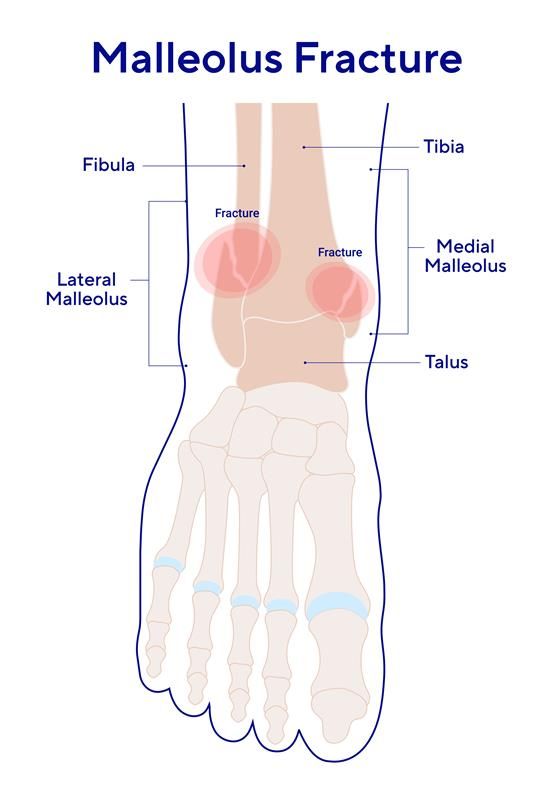
Malleolus fracture is a common form of ankle fracture. It affects one of the bony reliefs located on each side of the joint: the external malleolus (fibula), the medial malleolus (tibia) or sometimes the posterior malleolus.
This ankle fracture often causes severe pain, significant swelling, and difficulty walking. Depending on its severity, treatment may require simple immobilization or surgery. Rehabilitation is a key step in regaining a stable and functional ankle.
Understanding the Different Types of Malleolus Fracture (1)
The ankle functions as a solid ring, formed by the bones (tibia, fibula, talus) and ligaments. When there is a fracture, this ring is broken. In general, if it is broken in one place, there is often a second bone or ligament injury. That's why a complete ankle examination is essential to make sure nothing goes unnoticed.
Doctors first identify the location of the fracture. There are several forms of malleolus fracture:
Isolated fracture of the medial malleolus
Isolated fracture of the external malleolus
Bimalleolar fracture (two broken malleoli)
Trimalleolar fracture (three broken malleoli)
Some medical classifications allow the stability of the fracture and the risk of ankle instability to be assessed. Precisely identifying the type of malleolus fracture makes it possible to adapt the treatment and limit long-term complications.
Accurately identifying the type of fracture allows you to choose the most suitable treatment and avoid long-term complications.
What are the symptoms of a malleolus fracture? (2)
The symptoms of a malleolus fracture usually appear immediately after the trauma:
sharp ankle pain
difficulty or inability to walk
rapid swelling
appearance of a bruise
sometimes visible deformation
Movement is very limited because of the pain. In more severe cases, the skin may be very tight, have blisters or a wound.
External Malleolus Fracture Treatment (3)
The fracture of the external malleolus corresponds to a break in the lower end of the fibula. Treatment depends mainly on the displacement of bone fragments and the stability of the ankle.
When the fracture is not displaced, i.e. the bones have remained in place, non-surgical treatment is usually sufficient. It is based on immobilization by short cast or walking boot for several weeks. In the majority of isolated and stable fractures of the external malleolus, support can be allowed gradually, according to the doctor's opinion. Follow-up X-rays are taken to check for proper consolidation.
On the other hand, if the fracture is displaced or the ankle is unstable, surgery is necessary. The surgeon puts the bone fragments back in the right position, then usually fixes them with a plate and screws. After the operation, support is usually limited for several weeks to allow for good healing.
Each type of malleolar fracture has its own particularities, and the therapeutic strategy is always adapted to the stability of the ankle and the damage to the associated structures.
Regular medical follow-up and appropriate rehabilitation are essential to regain mobility, strength and stability of the ankle.
Bimalleolar and trimalleolar fracture: what are the differences? (1)
A bimalleolar fracture is when two malleoli are broken. Most often, these are the medial malleolus and the external malleolus. More rarely, the fracture involves the external malleolus and the posterior malleolus. Because two points in the ankle "ring" are affected, this fracture is usually unstable and may be accompanied by a displacement of the joint.
The trimalleolar fracture is more severe. The three malleoli—inner, outer, and posterior—are fractured. The joint is then very unstable, with a high risk of dislocation. This type of fracture most often requires surgical management.
Conversely, there are also isolated fractures, which affect only one malleolus, internal or external. They can be more stable, depending on the movement of the bones and the condition of the ligaments.
Understanding the number of malleoli affected makes it possible to assess the severity of the injury and to adapt the treatment.
How long does it take to heal after a malleolus fracture?
For a bimalleoid fracture:
Your recovery time depends on the type of fracture you had, your age, the strength of your bones, and your overall health.
On average, it takes 4 to 8 weeks for the bone to start repairing well. After the operation, you will usually not be able to put your foot on the ground for at least 4 weeks.
Complete healing may take 6 months or more. It is also normal for your leg or ankle to remain swollen for several months, sometimes up to a year after surgery. (4)
For a trimalleolar fracture:
If you have had surgery, you will not be able to put your foot on the ground for a while. This duration will depend on the severity of the injury and the stability of your ankle.
If the ankle is very swollen, the operation can be postponed. Severe swelling can cause blisters on the skin and increase the risk of infection. This can therefore lengthen the healing time.
Rehabilitation with a physiotherapist is essential for a good recovery. It usually begins between two and four weeks after the operation. Complete healing can take up to a year. (5)
Rehabilitation following a malleolus fracture (6)
Rehabilitation is done in stages. The rhythm depends on your fracture and your doctor's instructions.
0 to 6 weeks
During this first phase, your ankle is protected. You wear a immobilizer boot at all times, except at rest and during sleep if permitted. Crutches are often necessary to avoid support. The goal is to let the bone consolidate while limiting swelling and pain.
6 to 8 weeks
While consolidation is progressing well, support is gradually resuming. The boot can be removed little by little, at first for short distances. It is advisable to start walking again in a safe environment, such as at home, before going outside.
8 to 12 weeks
At this stage, the bone is usually well consolidated. Daily activities can resume gradually. Larger efforts can still cause slight swelling.
After 3 months
There is no longer a specific phase, but the improvement continues for several months. The ankle may remain a little stiff or swollen. If pain or stiffness persists, additional follow-up may be proposed.
Each person recovers at their own pace. Followingthe medical instructions is essential to regain a stable and comfortable ankle.
FAQ
In the event of a fracture of the malleolus, you should not walk without medical advice. Pressing too early can displace bone fragments and delay healing.
The resumption of walking depends on the type of malleolus fracture and the treatment performed. It is always progressive and medically supervised.
After an ankle fracture, the pain is normal, especially in the first few days. It is part of the healing process. The medical team will set up an appropriate treatment to relieve you.
If you have surgery, pain medication is often given by infusion in the first few hours. Then, the baton is taken over by tablets. If you have not had surgery, the treatment is done directly orally.
Several types of medications can be used:
classic analgesics such as paracetamol,
anti-inflammatories,
and sometimes opioids when the pain is greater.
Your doctor may combine several medications to get good relief while limiting opioid doses.
Opioids can be effective, but they are powerful drugs that can lead to addiction if used for too long. It is therefore important to strictly adhere to the prescription and stop as soon as the pain subsides.
For a malleolus fracture, which is a form of ankle fracture, pain management follows the same principles. In addition to medication, rest, elevating the leg and cooling can also help reduce pain and swelling.
1.Hermena S, Slane VH. Ankle Fracture. [Updated 2025 Feb 15]. In: StatPearls [Internet]. Treasure Island (FL): StatPearls Publishing; 2025 Jan-. Available from: https://www.ncbi.nlm.nih.gov/books/NBK542324/
4.Reddyreddy S, Stead T, Mangal R, Lopez-Ortiz C, Wilson J, Ganti L. Lateral Malleolar Fracture. Orthop Rev (Pavia). 2022 Nov 30; 14(4):37619. DOI: 10.52965/001C.37619. PMID: 36589515; PMCID: PMC9796999 https://www.orthobullets.com/evidence/33298680?utm
5.Christopher Patrick Bretherton et al. Early versus delayed weight-bearing following operatively treated ankle fracture (WAX): a non-inferiority, multicentre, randomised controlled trial, The Lancet, Volume 403, Issue 10446, 2024, pages 2787-2797, ISSN 0140-6736, https://doi.org/10.1016/S0140-6736(24)00710-4.
Walking boots or plaster casts: which solution should you choose to immobilise your leg?
Several recent studies have shown that walking boots allow for recovery that is as fast as, or even faster than, plaster casts for certain lower limb injuries.