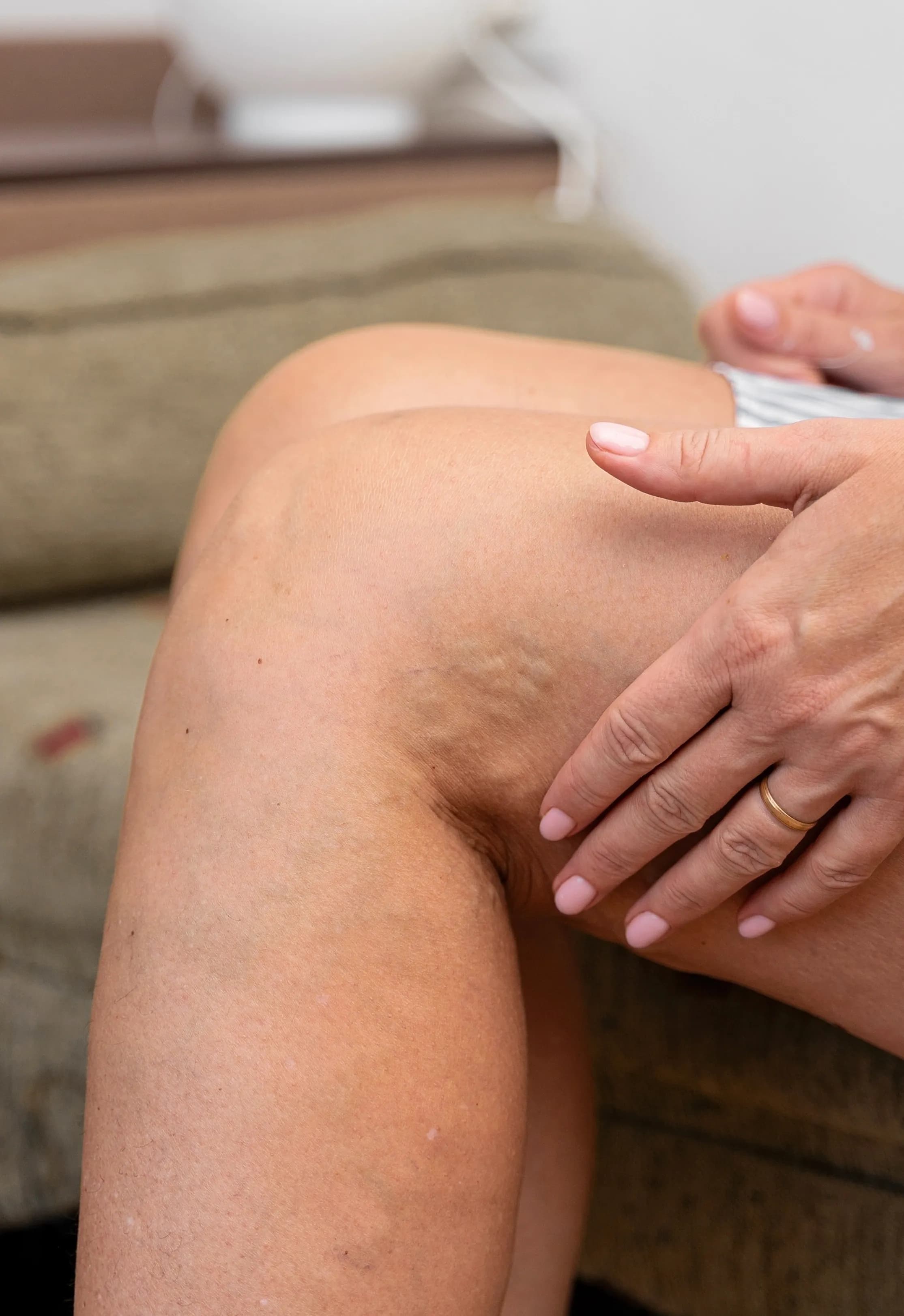
Did you know that in France, chronic venous disease affects about 18 million people, or nearly 30 to 40% of the adult population1? This pathology, which affects women more often and whose frequency increases with age, can lead to severe symptoms1,2.
To act effectively against heavy legs, varicose veins or edema, it is important to understand the "mechanics" of your legs.
Venous anatomy: a double interconnected network
The venous system of the lower limbs is a complex machinery divided into two main systems , separated by the muscular fascia.
The deep venous network: The main highway.
Located deep in the muscles, it is responsible for transporting 90% of venous blood to the heart2. It is a low-pressure but high-volume system. The veins are supported by the muscles and/or fascia. This allows the vein to pump venous blood upwards while walking, engaging the muscles
The superficial venous network: Secondary roads.
It is the one that we see (or guess) under the skin. It drains the skin and subcutaneous tissues. It is organized around two major veins2:
The Great Saphenous Vein (SVV): The longest vein in the body, it runs from the inner ankle to the groin2.
The Small Saphenous Vein (PVS): Visible under the skin, it starts at the back of the ankle and goes up to the crease of the knee2.
Perforating veins: The link between superficial and deep veins.
These veins connect the superficial veins to the deep veins. They act as bridges across the muscle, allowing blood to pass from the surface to the depths2.
How does blood rise?
The challenge of venous return is to bring blood back from the feet to the heart, against gravity, especially when standing2. The body uses two mechanisms for this2.
The calf muscle pump: Your "peripheral heart"
When you walk, the contraction of the calf muscles crushes the deep veins and propels the blood upwards2. It is the main driver of venous return.
Moving: When standing, venous pressure is high (80 to 90 mmHg). However, when the calf muscle pump is activated, for example by walking or standing on your tiptoes, it decreases considerably (20 to 30 mmHg)3.
When stopped: Without muscle contraction, the pressure remains high, promoting heaviness2.
Valves: The anti-reflux system
To prevent blood from flowing back down under gravity, the veins are equipped with check valves called venous valves2. They open to let blood flow to the heart and close immediately to block any downward flow.
What is Chronic Venous Insufficiency (CVI)?
Venous insufficiency occurs when the previous mechanisms malfunction. The main cause is venous hyperpressure, accompanied by an alteration of the vein wall and/or valves. These mechanisms will then cause the veins to dilate, leading to what is called venous reflux2. Instead of rising, the blood stagnates or descends in the legs.
The symptoms are numerous and can vary in intensity:
Itchy skin3
Feeling of heavy legs, discomfort3
Edema, often in the ankles2,3
Varicose veins, dilated veins visible under the skin2,3
It is an acute complication of chronic venous insufficiency1. A clot (thrombus) forms, partially or totally obstructing a vein1. This is called venous thrombosis. It can take two forms:
Superficial Vein Thrombosis (SVT)1 : The clot affects a vein under the skin (often a varicose vein). Although less serious, it can sometimes be associated with profound damage.
Deep Vein Thrombosis (DVT)1 : The clot is located in a deep vein. It is a medical emergency because the clot can migrate to the lungs and cause a pulmonary embolism1.
Risk factors and diagnosis of venous insufficiency
Why are some people affected? There are many factors: heredity (90% risk if both parents have varicose veins), age, female sex, pregnancy, smoking, exposure to heat, obesity, prolonged standing or sitting and a sedentary lifestyle1.
The diagnosis can be clinical, but Doppler ultrasound (Duplex Ultrasound) is currently the reference diagnostic technique for chronic venous insufficiency. Thispainless examination makes it possible to visualize flows, detect the presence of venous obstruction and venous reflux in the superficial and deep veins as well as accurately map the patient's venous anatomy2.
At the first signs (heaviness, spider veins), it is important to consult a doctor to avoid progression to more severe stages.
Lebreton-Legarçon, C., & KoÇak, F. (2020). Venous insufficiency, a chronic and progressive disease. Pharmaceutical News, 59(594), 8-12. https://doi.org/10.1016/j.actpha.2019.12.023
Youn, Y. J., & Lee, J. (2018). Chronic venous insufficiency and varicose veins of the lower extremities. The Korean Journal Of Internal Medicine, 34(2), 269283. https://doi.org/10.3904/kjim.2018.230
De Maeseneer MG, Kakkos SK, Aherne T,et.al. Editor's Choice - European Society for Vascular Surgery (ESVS) 2022 Clinical Practice Guidelines on the Management of Chronic Venous Disease of the Lower Limbs. Eur J Vasc Endovasc Surg. 2022 Feb; 63(2):184-267. DOI: 10.1016/J.EJVS.2021.12.024. Epub 2022 Jan 11. Erratum in: Eur J Vasc Endovasc Surg. 2022 Aug-Sep; 64(2-3):284-285. DOI: 10.1016/J.EJVS.2022.05.044. PMID: 35027279.
Compression stockings have become a daily ally to relieve heavy legs, improve circulation and prevent certain venous disorders. But are you wondering if keeping your compression stockings on overnight is a good idea?
Venotonics are widely used drugs for heavy legs; But the Haute Autorité de Santé judged their medical serviceto be insufficient in 2001, and they were completely de-reimbursed in 2008. They relieve symptoms — but they don't treat venous disease. Here's what it means for you.